
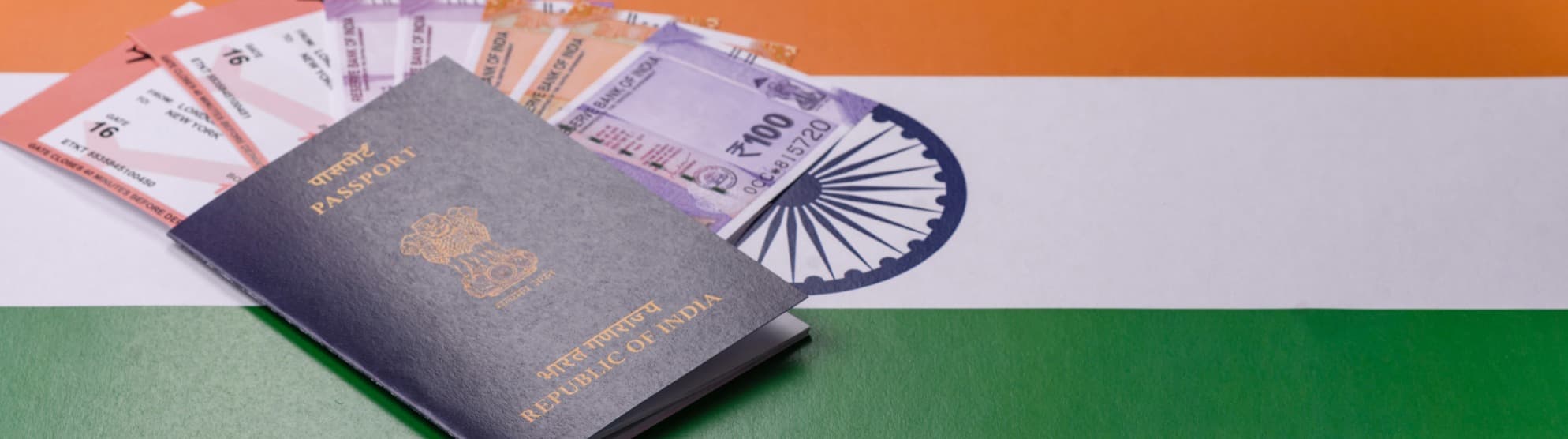
Visa for moving to India
Entry, e-Visa, Employment Visa, FRRO Registration and Customs Planning at a Glance
Price Calculator
Price Calculator
A few steps to your personal price
Step 1 of 3
Don't know your moving volume? In the next step, simply describe your move in your own words — our AI estimates the volume for you.
- Route
- Size
- Contact
Where is your move going?
Enter the loading and unloading address — we calculate the route for your move.
Don't know your moving volume? In the next step, simply describe your move in your own words — our AI estimates the volume for you.
- Truck
- Container
- Plane
Non-binding and free — a survey only comes if you want one.
Are you planning your move to India?
Then your visa, entry process, registration, customs and transport need to be properly aligned. India is not visa-free for German citizens. The correct visa must be applied for before entering the country – either through an Indian diplomatic mission or, depending on the purpose of travel, as an e-Visa. There is no visa on arrival.
For a real move to India, a short-term tourist setup is usually not sufficient. Anyone who wants to work there, stay longer, relocate with family or import household goods needs a reliable residence and moving plan.

When Do You Need a Visa for India?
German citizens generally require a visa to enter India. This must be applied for before departure. Depending on the purpose of stay, the application can be submitted via an Indian diplomatic mission or as an e-Visa through the official Indian online portal.
A visa is particularly relevant for:
- Moving to India
- Taking up employment in India
- Employer assignment
- Long-term project stays
- Family reunification
- Study, research or training
- Business stays
- Importing household goods
- Stays lasting several months
- FRRO/FRO registration requirements
Important: Anyone emigrating to India or moving there for work should not treat the visa process like a standard holiday trip. The purpose of stay must exactly match the visa category.
Related topics
- Indian customs regulations → Find out more now
- Emigrating to India? → All the important information
Which Visa Types Are Relevant When Moving to India?

Employment Visa India: Work Visa for Professional Stays
For many skilled workers, expats and assigned employees, the Employment Visa is the central visa category. It may apply when a person is employed in India by a company or organisation, or works there in a qualified professional context.
Important: The Indian Embassy in Berlin lists, among other things, a passport with at least six months’ validity and two blank pages, proof of qualification and the employment contract between the Indian employer and the applicant as requirements for an Employment Visa.

Business Visa India: A Business Trip Is Not the Same as Employment
A Business Visa may be relevant for business activities such as meetings, negotiations, market exploration or business development. However, it is not automatically the right solution for operational work, local assignments or permanent employment in India.
Important: Choosing the wrong visa category can create problems during entry, stay, registration, departure and future applications.

Entry Visa / X Visa: Relevant for Certain Family and Special Cases
An Entry Visa may be relevant in individual cases for certain family members, persons of Indian origin or special purposes. For accompanying partners, children or family members, it should be checked early which category matches the main applicant and the specific purpose of stay.

India e-Visa: Practical, but Not Suitable for Every Move
The e-Visa can be relevant for certain purposes such as tourism, business or conferences. For a long-term move, employment or complex relocation cases, it is often not the right solution.
Important: An e-Visa is also not available with a temporary passport.
Finding the Right Visa for Your Move to India in 6 Steps
- 1.
Define the Purpose of Your Stay
First, clarify why you are moving to India: work, assignment, business, family, study or a long-term private stay. The purpose of stay determines the visa category.
- 2.
Choose the Right Visa Category
For a work-related move, an Employment Visa is usually relevant, or depending on the situation, a Business Visa. For family members, an Entry Visa may be relevant. A tourist visa is not automatically suitable for work, NGO activities, journalism or long-term relocation.
- 3.
Apply Before Entering India
The visa must be applied for before entering India. There is no visa on arrival. The e-Visa must be applied for at least four days before the planned date of entry; the permitted length of stay depends on the respective e-Visa category.
- 4.
Involve Your Employer and Prepare the Documents
For a work visa, the employer plays a central role. According to the Indian Embassy in Berlin, an Employment Visa may be granted to qualified professionals who are employed by a company or organisation in India on a contractual or employment basis. For Employment Visas, the documents listed include a valid passport, proof of qualification and the employment contract with the Indian employer.
- 5.
Plan FRRO/FRO Registration
For a planned total stay of more than six months, or if the visa contains a corresponding requirement – for example with an Employment Visa – registration with the responsible FRO or FRRO is mandatory. This must be completed within 14 days of arrival.
FRRO Registration in India – Mandatory for Longer Stays
For longer stays or where required by the visa, foreign nationals must register with the responsible Foreigners’ Regional Registration Office or Foreigners’ Registration Office. In these cases, the deadline is 14 days after arrival.
Failure to register is not a minor formality. According to the German Federal Foreign Office, it can regularly result in departure being blocked at the airport and a separate exit permit having to be obtained from the FRRO. This may require returning to the last place of residence within India and can cause several days of delay.
- 6.
Synchronise Moving, Customs and Entry
Container shipping, air freight, residential address, visa, e-Arrival Card, FRRO registration and customs documents must be coordinated. Anyone who ships household goods too early risks delays, additional costs and storage fees.
Extending a Visa or Overstaying? Not a Good Strategy for Your Move to India
According to the German Federal Foreign Office, extending a tourist visa after entry is only possible in justified exceptional or emergency cases through the responsible FRRO. Anyone who does not leave within the validity period of the visa may face imprisonment and a multi-year entry ban.
For your move planning, this means: do not rely on a buffer strategy such as “we’ll extend it locally later”. India is formal in this regard. The correct status must be clarified before the move.
Common Entry Mistakes – and How to Avoid Them

- Choosing the wrong visa category: Tourism, business and employment are not interchangeable. Entering with the wrong status creates risk for the entire relocation process.
- Confusing an e-Visa with a relocation setup: An e-Visa is practical, but not automatically the right solution for employment, family relocation or long-term stays.
- Forgetting the e-Arrival Card: The e-Arrival Card is required in addition to the visa. It can be completed online from 72 hours before arrival.
- Shipping household goods too early: If the container arrives before visa, address, customs status and local documents are clarified, avoidable costs arise.
- Underestimating FRRO registration: For stays of more than six months or where required by the visa, registration within 14 days of arrival is mandatory. Missing this requirement can block departure.
- Not checking the entry stamp: The German Federal Foreign Office points out that passports are not always stamped upon entry. Without an entry stamp, significant difficulties may occur when leaving the country.
How DACHSER & KOLB Supports You With the Visa Setup for Your Move to India

Aligning Visa Timing and Move Planning
We coordinate moving date, entry, visa timing, employer requirements, residential address and transport lead time so that your India move remains operationally manageable.

International Moving Logistics from a Single Source
From the survey and packing to sea freight or air freight and final delivery in India, you receive structured planning with clear responsibilities.

Customs Preparation for India
We support you in preparing the relevant moving and customs documents so that your household goods do not get held up due to missing information or poor timing.

Support in Case of Delays
If visa, registration, residential address or start of work are delayed, storage solutions, part shipments and flexible transport options help reduce risk.
Customs and Household Goods: Why the Visa Matters for Your Move to India
- Your residence status affects the import of your household goods. For an international move to India, the following points are relevant, among others:
- Visa and purpose of stay
- Passport details
- Entry date and local address in India
- Packing list, declared values and transport documents
- Customs forms
Additional customs rules apply when importing goods into India. The German Federal Foreign Office mentions, among other things, declaration requirements for foreign currency from USD 5,000 in cash or travellers’ cheques, as well as for certain high-value items. Gold coins, gold bars, weapons, e-cigarettes, pornographic material and certain protected animal and plant products are also prohibited or strictly regulated.
Special requirements apply to dogs and cats, including rabies vaccination and an international health certificate issued by an authorised veterinarian.
Legal notice
This page provides practical guidance on visas for moving to India. It does not replace legal advice or binding information from the Indian authorities. The current information provided by Indian diplomatic missions, the official Indian Visa Online Portal, the Bureau of Immigration, the responsible FRRO/FRO offices and the German Federal Foreign Office is authoritative.
FAQ – Frequently Asked Questions About Visas for Moving to India
Do German citizens need a visa for India?+
Yes. German citizens need a visa to enter India. The visa must be applied for before entry; there is no visa on arrival.
Is there a visa on arrival for India?+
No. According to the German Federal Foreign Office, visas are not issued upon entry.
What is the e-Arrival Card for India?+
The e-Arrival Card is a digital entry form that must be completed online before entering India. It is not a visa and does not replace a valid visa.
When do I have to complete the e-Arrival Card?+
The e-Arrival Card can be completed online from 72 hours before arrival in India.
Which visa do I need if I want to work in India?+
For employment, an Employment Visa is relevant in many cases. The specific category depends on the employment relationship, employer, assignment model and purpose of stay.
Do I have to register after entering India?+
For a planned total stay of more than six months, or if the visa contains a corresponding requirement, registration with the FRO or FRRO is mandatory within 14 days of arrival.
Can I extend my visa in India?+
A tourist visa can only be extended after entry in justified exceptional or emergency cases through the responsible FRRO. Overstaying can have serious consequences.
When should I plan my move to India?+
As soon as visa, purpose of stay, employer or sponsor documents, residential address, entry date and customs requirements have been reliably clarified. Transport should not be planned in isolation, but together with visa, FRRO and customs timing.
Why DACHSER & KOLB is the right choice

Personalized consultation
Detailed needs analysis for customized relocation solutions.

Relocation planning from A to Z
Complete relocation planning: from packing to unloading, all from a single source.

Reliable network
Global network for safe, seamless transport.
We are here for you
Were we unable to answer your questions about entry requirements and visas for your move to India?
Then do not hesitate to contact us.

Discover our moving guides—your guide to a smooth move!
You will find valuable tips and answers to your questions in our extensive collection of moving guides. This will ensure that you are well prepared! If anything remains unclear, we are always happy to assist you.

Indian customs relocation
Planning a move to India? Find all key customs regulations, documents, deadlines, restricted goods, and tips for expats, returning residents, and diplomatic shipments.

International Move
Have you been bitten by the travel bug and would like to emigrate? Then you have come to the right place and your belongings are in the best of hands. For many years there has been nothing we would rather do than organize international removals across continents. Whether by ship, by plane or over land.

India
Experience India – a country brimming with color, festivals, and striking contrasts. From bustling cities and spiritual sites to the Himalayas, beaches, and centuries-old traditions, India combines cultural diversity, vibrancy, and an exceptionally rich way of life.